WHY CLEE ?
Most platforms protect clients.
Clee protects the business.
Built from the floor, not the boardroom. By operators, for operators — closing the gap between what the beauty industry earns and what its infrastructure was designed to handle.

ABOUT
A platform built from the floor, not the boardroom.
Clee was not designed by a software company trying to enter the beauty industry. It was designed from inside it.
ORIGIN
Every rule, every automation, every enforcement mechanism in the platform exists because something in a real business was broken — and the available tools refused to change or adapt it.

01 / DIAGNOSIS
The hidden cost of the tools you're already using.
Every clinic runs on software. Few run on systems. Fresha, timely, and the rest were built to take a booking. They do that competently. What they can't do is protect the business around the booking — the deposit logic, the rebooking flow, the cancellation enforcement, the slot that went empty at 2pm on a Thursday and stayed empty.
The result is a category of loss most operators never measure: clients who drifted out of rotation, packages that were never completed, last-minute cancellations absorbed in silence, and a marketing calendar that runs on whatever campaign someone remembered to send. It isn't incompetence. It's infrastructure.

02 / MECHANISM
Why current systems create disorder.
Conventional booking platforms treat every appointment as a standalone transaction. They capture the booking and stop there — leaving deposits, cancellations, rebooking, and retention for the operator to manage outside the system.
Each function operates in isolation. A calendar that doesn't enforce policy. A payments flow that doesn't connect to attendance. A marketing layer that doesn't know which clients have drifted. The business absorbs what the software refused to govern.
The result isn't chaos in the dramatic sense. It's disorder — quiet, chronic, and expensive. Slots go empty. Clients slip out of rotation. Revenue leaks at the edges while the dashboard still looks full.
03 / RESOLUTION
Introducing Clee.
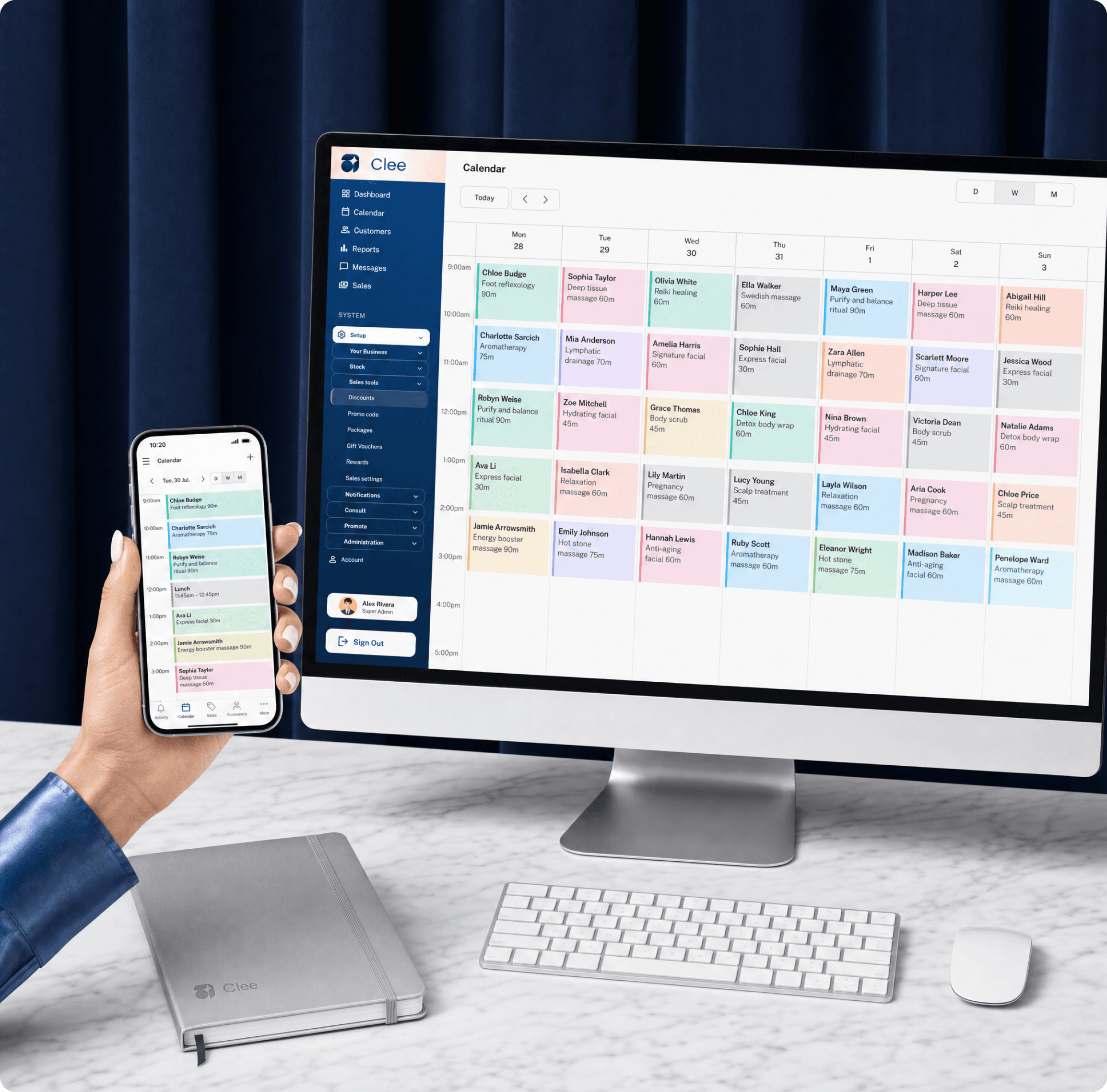
Clee is a Beauty and Wellness Operating System — a single platform that governs bookings, payments, client behaviour, marketing, and retention through rules the business sets once and the software enforces permanently.
It runs the operational layer of a business the way financial software runs the books: in the background, without interpretation, without exception.
Clients book within the rules. Deposits are taken within the rules. Rebooking happens within the rules. The calendar fills itself. The marketing runs itself. The policies hold, whether the owner is on the floor or out of the country.

04 / CATEGORY
A new category.
The industry has had booking tools for two decades. It has never had an operating system.
That distinction matters. A tool executes individual tasks. An operating system coordinates them — so that a deposit rule, a cancellation policy, a package structure, a waitlist, and a rebooking sequence all behave as one logic, not five plugins. Clee is the first platform designed from that premise.
How Clee Compares
Most platforms take bookings. Clee takes care of what happens around them, so you do not have to.
Stacked upsells at checkout
A client adds a $102 service to their cart. At checkout, a $500 package appears that includes that same service inside a larger offer. They choose the $500, and your average sale grows by $400.
Checkout is just a cart and a total. There is no way to surface a larger, smarter offer at the moment a client is ready to pay.
Your client list stays yours
Your staff see their schedule, their bookings and their hours. They do not see your takings, your revenue or the client database. When a staff member leaves, your database stays with you.
Most platforms bundle permissions, forcing a choice between letting staff work and protecting your numbers and your client list.
Staff clock in and out through their login
Your team logs in at the start of their shift and out at the end. Hours are recorded automatically and flow straight into the payroll report. No paper timesheets, no app to download, no chasing anyone at the end of the fortnight.
Time tracking is usually a paid add-on or a separate tool, and staff have to remember to use it. Most owners end up reconciling hours by hand anyway.
Your service rules are respected, quietly
You require four weeks between sessions. A client tries to book at three. The calendar simply does not show that date. They pick week four and never know a rule was applied.
The calendar shows every open slot. Your spacing rules live in your head, and a client can book straight through them.
Contraindications blocked at the service level
A client has a contraindication for a specific service, flagged on their file. When they go to book, that service does not appear for them. A new hire does not have to read every file perfectly, and no one has to remember what was noted months ago. The system prevents the booking before it ever becomes an error.
Contraindications sit in notes that staff have to read every time. One missed line, one new hire or one busy day, and a client is booked into something they should not be.
Packages look after themselves
A client buys a package of three sessions and books all three online, within the intervals you have set. The spacing is locked in from the moment they pay. Nothing is left to chance.
Packages are sold as credits. The client has to come back and book each session themselves, often badly spaced, or never.
Rescheduling rules you set, enforced for you
You decide the rules, built into the policies clients agree to when they book. For example, the first two reschedules are free, the third forfeits the deposit, and the fourth converts it to product credit. Whatever you design, Clee enforces it quietly, and you are not the one delivering the message.
No platform lets you design rescheduling rules in tiers. Every reschedule is treated the same, and enforcing the consequences falls on you.
Cancellations become new bookings, fast
A client cancels their Friday 2 pm at 9 am. The waitlist is notified automatically by text and email. The first to confirm takes the slot, by your rules. Your day is full again before your second coffee.
Most platforms will not notify a waitlist automatically. You have to message people yourself, and when you get busy the slot stays empty.
Abandoned checkout recovery for services
A client picks a time and closes the tab before paying. An email finds them two hours later. If they still have not booked, a text arrives at 9 am the next morning. Most of the time, they book.
Abandoned-cart recovery is common in ecommerce, but almost never offered for service bookings.
Last-minute gaps fill from your own clients
A 3 pm cancels at 11 am. The slot is offered to clients who have had that service before, and it is booked within the hour. No social post, no discount.
No platform matches client history to open slots. Gaps get filled manually, or not at all.
Your best clients win contested slots
Two clients open the page at the same moment and both select Saturday 10 am. They confirm within seconds of each other. The loyal client gets the slot. The serial rescheduler sees the next available time.
Booking is strictly first come, regardless of loyalty. Your best client can lose their regular slot to a stranger with a faster connection.
Pre-built plans that run on their own
You build a plan once, whether that is six sessions across twelve weeks or a year of maintenance. From then on, the system sends the follow-ups at the right moments, on the intervals you set. The client stays on track. You never chase.
Reminders elsewhere are generic. No platform lets you build a plan once for one client and have it send its own follow-ups on the schedule you set.
Difficult clients are gently deprioritised
A late-canceller logs in and sees only Tuesday 11 am and Thursday 3 pm. They do not realise their view is narrower. You never had to have the conversation. And if the pattern is more serious, a full block is available too.
Only a few platforms offer anything close, and never with this level of control.
Deposits that protect your time
A client books a $120 service and pays the $30 deposit you set, or chooses to pay the full amount up front. The slot is held, and a casual no-show now costs them, not you.
Deposits are often all-or-nothing or bolted on through a third party. Few let you set a different rule for each service or each client.
Reminders, aftercare and rebooking, on your timelines
A reminder text goes out 24 hours before. A care message follows the morning after. A rebooking prompt arrives weeks later, exactly when you decide. All of it runs on its own.
Most platforms send a single fixed reminder and stop there. Aftercare and timed rebooking prompts are rare, and rarely on a schedule you control.
One screen that does more than take payment
You ring up a service and a take-home product on a single screen, apply a discount, take payment, then rebook the client, log a note and send a feedback request before they reach the door.
Checkout takes the money and ends there. Rebooking, notes, product recommendations and feedback usually live in separate tools, if they exist at all.
A marketplace that fills gaps with new clients
A slot you would have lost is shown to new clients nearby. It books, and you pay commission only on what it earns you. Nothing upfront, and nothing for the gaps it does not fill.
To reach new clients elsewhere you run ads or join a paid directory that charges you whether it works or not, and none of it is tied to your actual empty slots.
A marketplace that stays premium
Your Marketplace profile carries no public star ratings. Clients can leave compliments, and private feedback only if you allow it. One off day never sits on your profile for the world to see.
Public directories reduce your business to a star average, where a single bad day can outweigh years of good work, and you cannot take it down.
Offers that escalate as the slot nears
A 2 pm slot sits open at 9 am at full price. By 11 am it carries a complimentary add-on, and closer in it can offer a small discount. Each step is a rule you set in advance, not a panic.
Filling a last-minute gap means manually posting a discount and hoping. There is no way to set an offer that changes on its own as the clock runs down.
Referrals on your own terms
You decide that three referrals earn a set reward, valid for a set time. When a client's third friend completes their first visit, the reward lands automatically, and the client can see how close they are.
Referral tracking is usually a paid add-on or a spreadsheet. Setting your own tiers, value and expiry, and having it pay out automatically, is rare.
Marketing written for your field, ready to run
You switch on a seasonal campaign built for your kind of business, and it goes out to the right clients without a brief, a designer or a single line of copy.
You get an empty email tool. The strategy, the copy and the timing are left to you, or to an agency you pay separately.
A website that also sells your products
Opt in and Clee hosts an optimised, beautifully designed site for your business, with online product sales built in, all for one monthly fee.
A booking widget bolted onto a site you built and pay for elsewhere, with a separate shop, a separate host and separate bills to stitch together.
You are not charged for growing your team
You add your second, fifth or tenth staff member and your plan price does not move. The team gets bigger, the bill stays the same.
Per-seat pricing is the norm. Every person you hire raises your monthly cost, so growing your team quickly penalises you.
Every location, one login
You run three sites from a single login, each with its own calendar and team, and one place to see how all of them are performing.
Multiple locations often mean multiple accounts or a pricey enterprise tier, with performance scattered across separate logins.
Your data, yours to take
Decide to leave and you export your full client list and history and walk out with it. No gatekeeping, no lock-in, no ransom for your own records.
Exports are often limited, awkward or withheld, so your client history can effectively belong to the software company rather than to you.
MARKET POSITION
Where Clee sits in the category.
Plotted across market presence and operator satisfaction, against the platforms clinics typically consider. The top-right is where a serious aesthetic business wants its software.
High Density Infrastructure
Built specifically for the complexity of multi-site operations.
Technical Superiority
Our placement is verified by independent operator surveys across the aesthetic index.
Rapid Integration
Switching from legacy ‘Contenders’ takes less than 48 hours with our data bridge.